
Reisen mit dem XsC
Reisen mit dem
XsC: Dein Zimmer fährt mit – günstig, flexibel, zukunftssicher
Im letzten Blogpost habe ich den XsC als thermischen Rückzugsort vorgestellt – als modulare Lebenszelle, die teure Sanierungen überflüssig macht und bezahlbaren Wohnraum schafft. Doch der XsC kann mehr als still im Schlafzimmer stehen. Er kann reisen.
Dieser Beitrag zeigt, wie aus der Wohnkapsel ein mobiles Zuhause wird – mit E-Pods, Bahn, Seilbahn, Luftschiff und Schiff. Und wie die Logik des Algorithm of Sustainability (AoS) diese Art des Reisens nicht nur möglich, sondern für viele Menschen nahezu kostenlos macht.
Die Grundidee: Dein Zimmer, immer bei dir
Stell dir vor: Du musst nie wieder Koffer packen. Du musst dich nie wieder an ein fremdes Hotelbett gewöhnen. Du reist einfach mit deinem eigenen Zimmer.
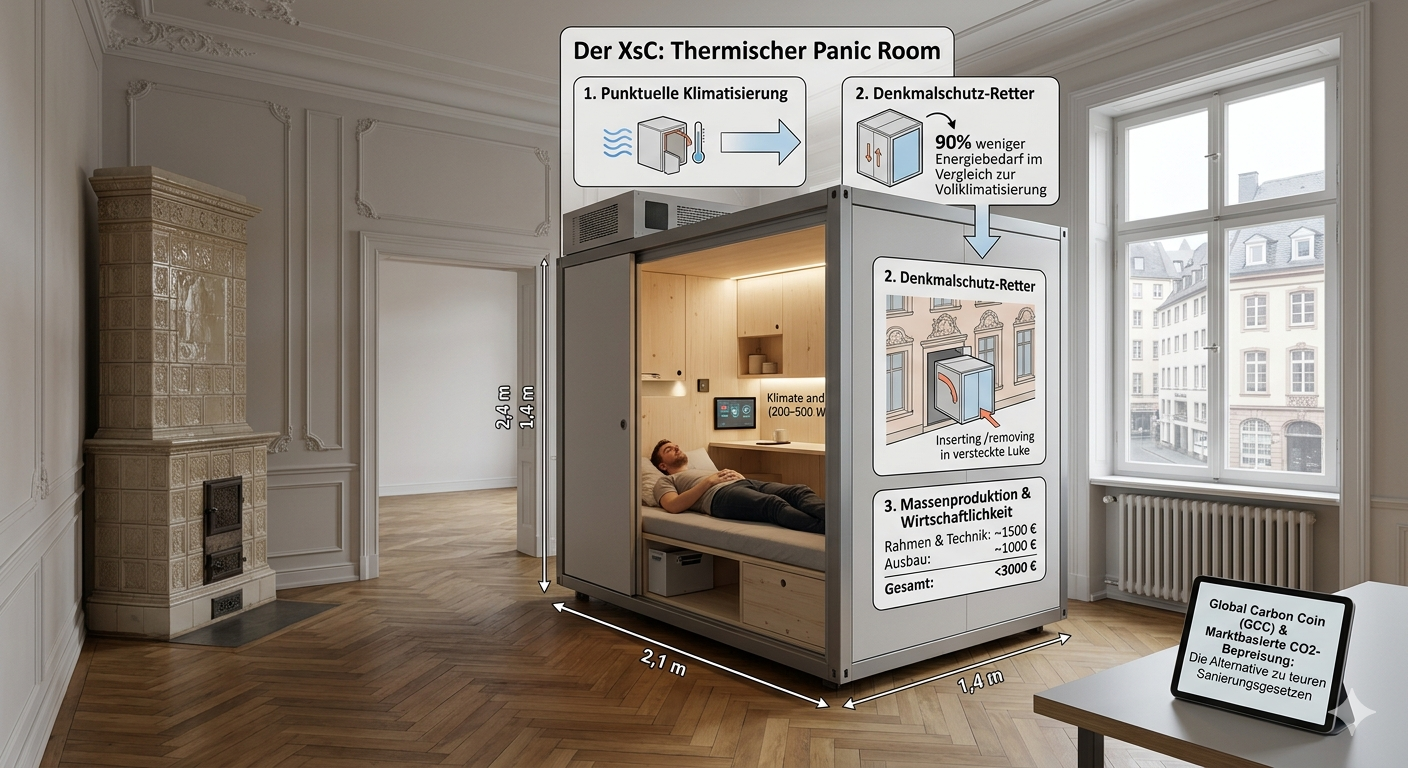
Der XsC ist genau das: ein standardisiertes Wohnmodul im Format ca. 2,10 m (Länge) × 1,40 m (Tiefe) × 2,20 m (Höhe) – mit einer Innenlänge von mindestens 1,90 m, so dass du ausgestreckt liegen kannst. Er enthält dein Bett, deine Technik, dein Klima. Und er passt auf jedes gängige Verkehrsmittel.
Die Reisekette sieht so aus:
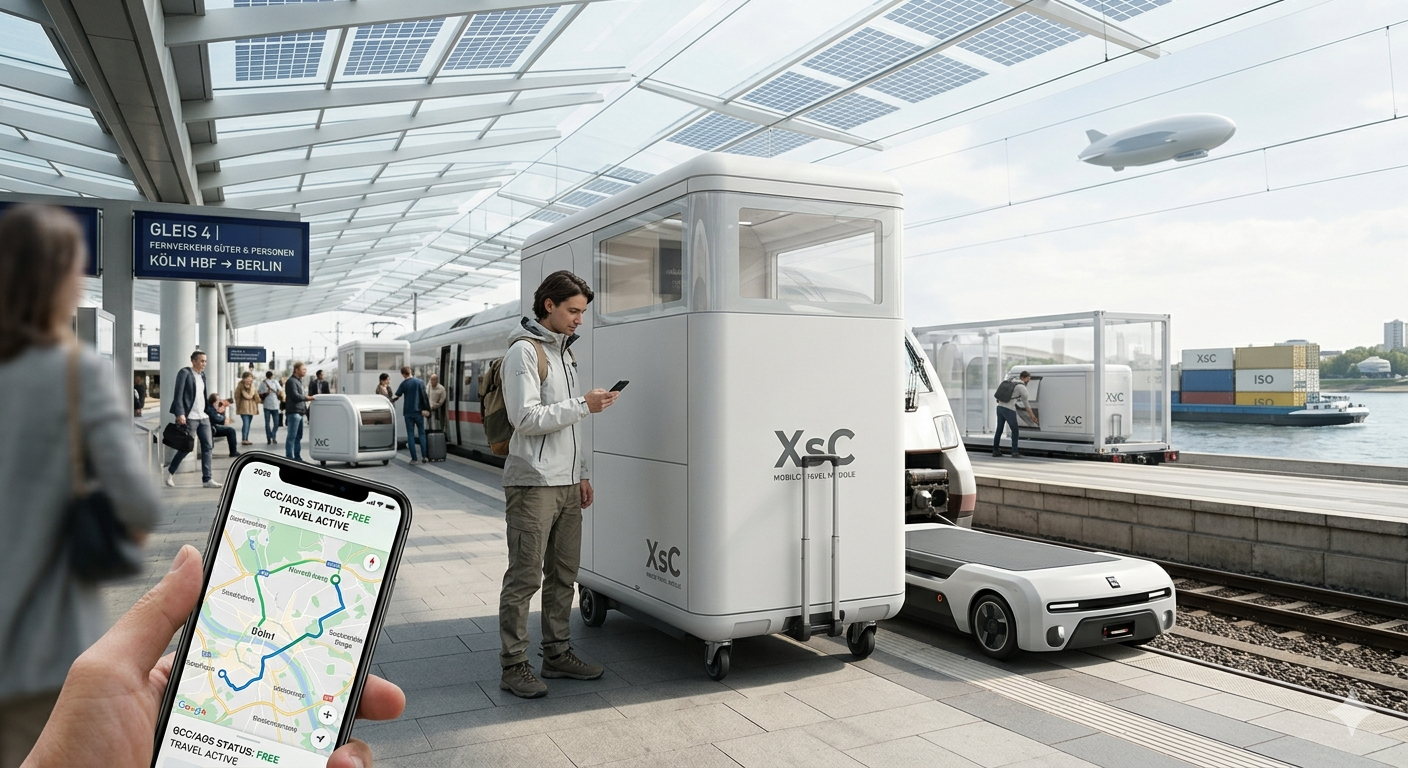
Haustür → E-Pod → Güterbahnhof → Bahn/Schiff/Luftschiff → Ziel-Güterbahnhof → E-Pod → Ziel
Du wirst mit deinem XsC auf einem elektrischen Pod abgeholt, am Güterbahnhof wird das Modul auf einen Zug verladen, du schläfst unterwegs in deinem eigenen Bett, und am Ziel bringt dich ein weiterer Pod an deinen gewünschten Ort. Du verlässt nie dein Zimmer.
Variabel wie ein Zollstock: Der ausziehbare XsC
Ein XsC ist nicht starr. Er kann seine Länge verändern – ähnlich einem ausziehbaren Tisch oder einem Teleskoprohr.
Kurze Variante (für Bahn & Straße):
Auf einem Güterwaggon bleibt auf einer Seite ein schmaler Gang frei. Dafür wird die kurze Länge von ca. 2,10 m gewählt. Die nicht benötigten Wandelemente werden auf dem Dach oder im Inneren verstaut.
Lange Variante (für Schiff & ISO-Container):
In einem 20 ft‑ISO‑Rahmen kann der XsC auf die volle Breite des Rahmens (~2,4 m) ausgezogen werden. Das schafft Platz für zwei Liegeflächen oder ein komfortables Wohngefühl.
Gekoppelte Variante (für Gruppen):
Zwei oder mehr XsC können miteinander verbunden werden. So reisen 2–4 Personen gemeinsam – mit verbundenen Schlafbereichen und einem gemeinsamen Wohnbereich. Auch hier wandern die nicht benötigten Trennwände einfach aufs Dach.
Economy auf Schienen: Der halbhohe Capsule-XsC
Nicht jeder braucht einen Steh-XsC. Für Reisende mit kleinem Budget oder für kürzere Strecken gibt es die halbhohe Variante.
Ein 20 ft‑Container fasst normalerweise vier XsC. Bei halber Höhe passen acht Capsule XsC in denselben Container – ähnlich wie in einem japanischen Capsule Hotel.
Die Bedingungen:
- Gemeinschafts-Waschräume im Zug oder auf dem Schiff
- Geteilte Sanitärbereiche (wie im Nachtzug)
- Keine Stehhöhe, aber bequeme Liegefläche
Der Effekt: Die Fahrtkosten pro Person sinken drastisch – weit unter denen eines normalen XsC. Für Studenten, Saisonarbeiter oder alle, die einfach nur günstig von A nach B kommen wollen, ist das eine echte Alternative.
Dynamische Preise: Wer flexibel ist, fährt fast umsonst
Die Transportkapazitäten für XsCs sind begrenzt – aber nicht gleichmäßig ausgelastet. Wer bereit ist, Slots mit geringer Nachfrage zu buchen, kann extrem günstig reisen.
Das System (ähnlich wie bei Flugtickets, aber transparenter) belohnt Flexibilität:
- Last-Minute-Buchung (freie Kapazitäten werden kurz vor Abfahrt verbilligt)
- Schwachlastzeiten (Mitternachtszüge, Werktage außerhalb der Ferien)
- Rückfluss-Optimierung (leere Container werden besonders günstig angeboten)
In Verbindung mit der Universaldividende (UD) des AoS – einem bedingungslosen Grundeinkommen, das jedem Bürger zusteht – könnte Reisen für viele Menschen nahezu kostenlos werden. Wer unterwegs arbeitet (als Digital Nomad, Erntehelfer, Saisonkraft oder kurzfristiger Experte), verdient sogar noch dabei.
Die Transportmittel: Alles, was Rollen, Schienen oder Rotoren hat
Der XsC ist so konzipiert, dass er auf jedes gängige Verkehrsmittel passt:
| Transportmittel | Vorteil für XsC |
|---|---|
| E-Pod (Straße) | Leicht, leise, steuerbegünstigt – holt dich zu Hause ab |
| Bahn (Güterwaggon) | Günstig, flächendeckend, nachts nutzbar |
| Seilbahn | Ideal für Gebirgsregionen, keine Straßen nötig |
| Luftschiff | Für schwer zugängliche Orte, extrem leise |
| Schiff (Binnen & Küste) | Platz für viele XsC, sehr günstig pro Kilometer |
Die AoS-Logik der Gefährungshaftung (je schwerer und schneller ein Fahrzeug, desto höher seine Haftung) gibt leichten, langsamen Transporten wie dem E-Pod oder der Seilbahn einen systematischen Wettbewerbsvorteil. Der XsC ist leicht – und profitiert davon.
Und wie wird das finanziert? Der GCC und die UD
Hier schließt sich der Kreis zum ersten Blogpost.
Der Global Carbon Coin (GCC) – ausführlich beschrieben hier – bepreist die Nutzung der Atmosphäre marktbasiert. Fossile Energien werden dadurch automatisch teurer, saubere Transporte (Bahn, Seilbahn, E-Pod) werden wettbewerbsfähig.
Die Universaldividende (UD) gibt jedem Bürger ein regelmäßiges, bedingungsloses Einkommen. Wer seine UD geschickt einsetzt – kombiniert mit günstigen Slots und gelegentlicher Arbeit unterwegs – kann die Welt bereisen, ohne sein Konto zu plündern.
Die Formel ist einfach:
UD + flexible Slot-Buchung + gelegentliche Arbeit unterwegs = nahezu grenzenlose Mobilität innerhalb der Fair Standards Zone (FSZ).
Unterschiedliche Varianten: Low-Tec und High-Tec
Auch auf Reisen gilt: Der XsC kann einfach oder smart sein.
| Merkmal | Low-Tec-Version | High-Tec-Version |
|---|---|---|
| Dämmung | Holzfaser, Schafwolle | VIP, Aerogel |
| Heizung/Kühlung | Infrarot (200–400 W) + Passivlüftung | Wärmepumpe (COP 3–4) |
| Sanitär | Trockentrenntoilette, Waschlappen | Vakuum-Toilette, 10–20 l Frischwasser |
| Strom | 1–2 kWh Akku, externes Balkonkraftwerk | 3–5 kWh LFP-Akku, Dach-PV |
| Konnektivität | Keine | LTE/5G, App, Fernüberwachung |
| Gewicht | 400–600 kg | 500–700 kg |
| Kosten (ca.) | 3.000–5.000 € | 8.000–12.000 € (Massenproduktion) |
Beide Versionen nutzen die gleichen standardisierten Schnittstellen – sie können also auf denselben Pods, Waggons und Hubs transportiert werden.
Ausblick: Der XsC als Baustein einer neuen Mobilitätskultur
Dieser Blogpost skizziert eine Vision – aber keine Luftschlösser. Alle technischen Komponenten existieren bereits: ausziehbare Container, E-Pods, Güterbahnhöfe, Seilbahnen, Luftschiffe. Was fehlt, ist die Standardisierung der Schnittstellen und die politische Umsetzung des AoS.
Der XsC ist nicht nur ein Produkt. Er ist ein Katalysator für eine neue Art des Reisens – ressourcenleicht, preisgünstig, menschenzentriert. Und er zeigt: Mobilität und Wohnen müssen kein Gegensatz sein. Sie können eins werden.
Fazit: Dein Zimmer fährt mit
Der XsC verwandelt das Reisen von einer stressigen Abfolge von Buchungen, Packen und Umgewöhnungen in eine kontinuierliche, komfortable Erfahrung. Er ist die kleinste Zelle einer mobilen, resilienten Gesellschaft.
Die Frage ist nicht mehr, ob du dir eine Reise leisten kannst. Die Frage ist, wohin du als nächstes fährst – mit deinem eigenen Zimmer.
*“XsC Container Konzept von Jörg Schreiner ist lizenziert unter einer Creative Commons Namensnennung – Weitergabe unter gleichen Bedingungen 4.0 International Lizenz. Lizenztext: https://creativecommons.org/licenses/by-sa/4.0/„*
 mehr brauchen




 Then financial assets no longer grow exponentially, but automatically tend toward the average. This demonstrates the self-regulating effect of the LL. (See chart)


